
Website development
Backed by a running systemAsk an AI assistant what your company does.
Fast, clear websites built so search engines and AI assistants both understand you.
The commercial shape of it
- Timeline
- 4 weeks to your first working version
- Cost
- The call is free; a scoping engagement follows, then the build is quoted against the scope it produces. The three steps and the figures
- Built for
- Professional services · Manufacturing · B2B software · Education
- Runs today as
What you get
- A fast, clear website on your own domain
- Words your team edits, with the site rebuilding itself
- A machine-readable layer, so assistants quote you correctly
- Contact forms wired into the systems you already use
- Speed and accessibility checked automatically on every change
- A handover session and a short written guide
The room it happens in
There is nothing on your site that a machine can read properly. So something gets made up about you, from old scraps and a five-year-old directory listing. Nobody can change a word without a developer, so the typo stays. And it takes four seconds to load on a phone, by which point they have gone.
Any of this sound familiar?
- People find your site and still cannot tell what you actually do.
- Nobody has updated it in two years because it is too hard to change.
- It looks wrong on a phone, which is where most people open it.
- You have no idea how many enquiries the site is losing.
- When someone asks an AI about your company, the answer is wrong.
If two or more of those are yours, this page is about you.
Whatever it just said is what your next customer is going to hear.
What it costs you
Not visitors. Accuracy. This is the version of your company that gets described to buyers when you are not in the room. And you cannot correct what you cannot see.
Why now
Search engines are no longer the only machines reading your website. AI assistants read it too, and they answer questions about you all day.
There is now a settled way to give them the right answer. It is called MCP, and the biggest names agreed on it fast: OpenAI in March 2025, Google and Microsoft that May. By December 2025 it had been handed to the Linux Foundation, backed by AWS, Google, Microsoft, OpenAI, Bloomberg and Cloudflare.
So being readable by machines is now a build decision, not a research project.
What we do differently
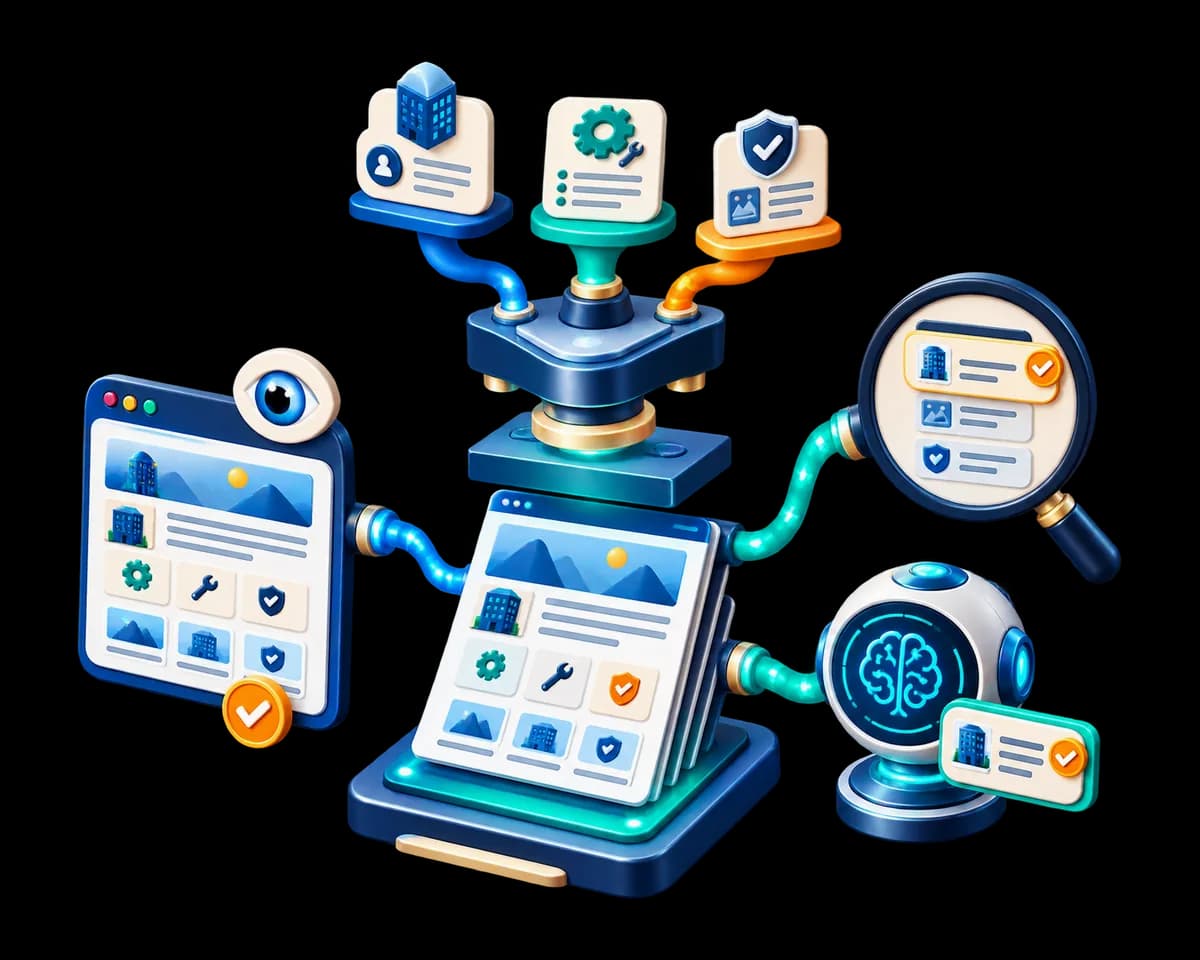
We build the machine-readable part first, not last. Structured data, a plain file listing what you do, and a live connection an assistant can query. Ask about your company and it gets your actual words back.
Your team edits the words, in one place. Change a sentence once. The page, the structured data and the machine layer all update together, because they read the same file. Nothing is kept in two places, so nothing drifts apart.
Speed and accessibility are checked by the computer. Colour contrast, layout on small phones, and keyboard use are all tested automatically. If any of them fail, the change does not go live.
Ask it from your phone
This site is the example. The connection is live, and you can point your own AI assistant at it right now. Not a screenshot. Not a meeting. A web address.
A buyer, mid-call, to their own AI: "What does Thinqmesh build, and what does a job with them actually cover?"
Their assistant, after reading our site: it lists the services and what each one covers, straight from the same file that draws these pages.
That is what we would build for you, on your words.
How it works
Structure. Your words, written down once, as the single source.
Build. The pages, with the machine-readable layer made alongside them.
Check. Contrast, small screens and keyboard use, all tested on every change.
Hand over. A session and a short guide, so your team edits without us.
What we guarantee
This job covers the site. Pages, structure, moving your existing words across, the machine layer, contact forms, and a handover with a written guide.
We will tell you plainly what the machine layer does. It makes you accurate to the systems that describe you, once someone finds you. It is not a way to get more visitors, and we would rather say that here than sell it as one.
Writing, branding and photography are separate crafts, and an online shop is a separate job with its own moving parts. We will point you at good people for the first three, and quote the fourth properly if you need it.
Four weeks covers a first working version, agreed in writing before we start. Very large programmes, work spanning many systems, and moving data out of software that cannot export it are all priced separately. Read what four weeks includes.
On every engagement
- You own it, and you can leave. Your code, your data, your accounts. Taking it in-house or to another supplier is a handover, not a negotiation.
- Built for India's DPDP Act. Identity kept separate from the consent and audit record, no personal data in URLs, and none in logs.
- Security enforced by the build. Secrets scanned on every commit, payloads size-checked before parsing, every write endpoint rate limited. If a check fails, nothing ships.
- Anything with AI in it is measured. An evaluation set, a human review step wherever a wrong answer costs money, and drift monitoring after go-live.
How we build, where your data lives, and exactly where we stand on certification — all of it is on our security page.
Asked and answered
Will the machine-readable part bring us more visitors?
Can our marketing person really edit this?
What if we want to move away from you later?
The other 11
Next step
Start with the one that hurts most
Bring your website address and one line on what you want people to understand. On the call we go through what an AI assistant says about you today, and what it would take to fix it.