
Mobile apps
Built to orderThe people who make most of your data have the worst tools for it.
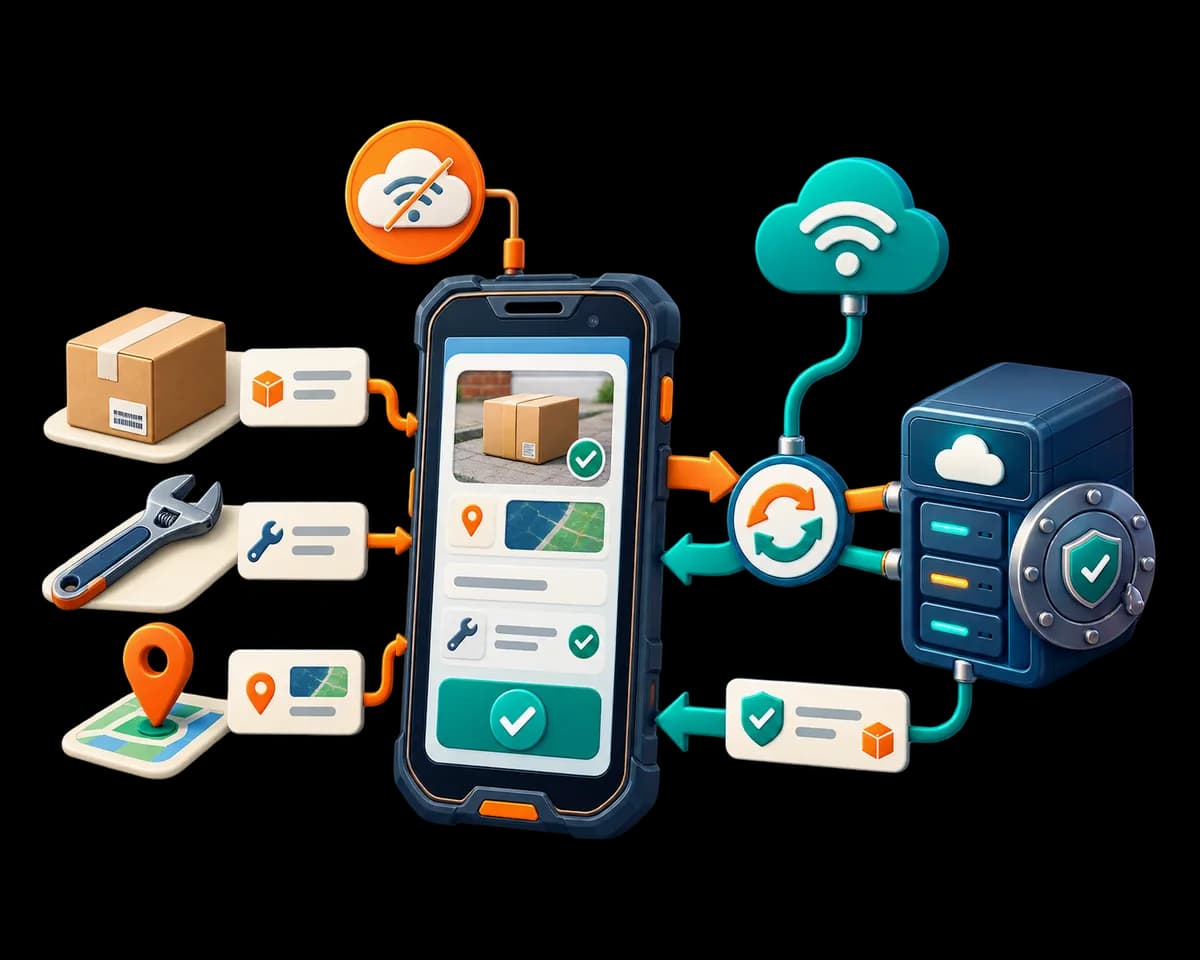
For people doing the work away from a desk. Same system as your other software, and it works with no signal.
The commercial shape of it
- Timeline
- 4 weeks to your first working version
- Cost
- The call is free; a scoping engagement follows, then the build is quoted against the scope it produces. The three steps and the figures
- Built for
- Field services · Manufacturing · Distribution and wholesale · Construction · Healthcare administration
What you get
- One app that works on both iPhone and Android
- Works with no signal, and catches up when the signal comes back
- Tested on a genuinely bad connection, not just in the office
- The same logins and permissions as your other systems
- Photos, barcodes, signatures and location, where the job needs them
- Published under your own store accounts, not ours
The room it happens in
Work gets written down hours late, by somebody else, with the mistakes that brings. The last app your team tried needed a signal, so somebody lost an hour in a warehouse and never opened it again. And it kept its own separate records, which stopped matching everything else within a year.
Any of this sound familiar?
- Your field team writes on paper, then someone types it in at night.
- Photos of jobs sit on personal phones.
- You find out about a problem on site the next day.
- There is no signal where the work happens, so nothing syncs.
- The office and the van are always working from different information.
If two or more of those are yours, this page is about you.
A technician finishes a job and writes it on paper. A driver rings the office to confirm a delivery. A supervisor counts stock into a notebook.
What it costs you
You make decisions on yesterday's picture. And your team quietly goes back to paper, which you usually find out during an audit.
Why now
Two things changed, and both are about the person holding the phone.
One app can now serve both phone types properly. A real field app used to mean two teams and two budgets. It does not any more.
And the best way to record something on site is often to say it. Your hands are full. Voice now works well enough to put in front of someone who has no interest in software at all.
What we do differently
It works with no signal. The app keeps what it captured and catches up later. That includes the tricky part: what happens when two people change the same job while both are offline.
Same system, same logins. No second set of records to go out of step. If someone loses access on Friday, they lose it in the app too, without anyone remembering to do it separately.
It records things where the work happens. Photos, barcodes, signatures and location, attached at the moment they mean something. Not typed up later from memory.
Ask it from your phone
The app is the phone, so this one is simple.
A supervisor, on site: "What is left on this job, and do we have the parts?"
The system: Two tasks open. Both need part 4471. Three in the Pune store, none on the van.
Supervisor: "Order two, and tell the customer we are back Thursday."
The other useful pattern is just reading. Today's numbers, without opening a laptop. It is far less work than people expect, and it is often what gets the app opened daily.
How it works
Capture. The job, recorded where it happens, with or without a signal.
Catch up. We agree the rules for clashes first, then test them on a bad connection.
Connect. Same system and permissions as everything else you run.
Publish. We put it in the stores under your own accounts, with crash reporting already switched on.
What we guarantee
We agree the clash rules before we build, not after you go live. What happens when two people edit the same job offline is the question most app projects find out the expensive way. We answer it in writing, per job type, and test it.
We publish under your accounts and see you through review. Apple and Google set their own review times. We plan the launch around that rather than promise a date that is not ours to give.
We price hardware once we have seen it. Scanners, printers and vehicle trackers vary enormously. Tell us what is out in the field and we will quote it properly.
Four weeks covers a first working version, agreed in writing before we start. Very large programmes, work spanning many systems, and moving data out of software that cannot export it are all priced separately. Read what four weeks includes.
On every engagement
- You own it, and you can leave. Your code, your data, your accounts. Taking it in-house or to another supplier is a handover, not a negotiation.
- Built for India's DPDP Act. Identity kept separate from the consent and audit record, no personal data in URLs, and none in logs.
- Security enforced by the build. Secrets scanned on every commit, payloads size-checked before parsing, every write endpoint rate limited. If a check fails, nothing ships.
- Anything with AI in it is measured. An evaluation set, a human review step wherever a wrong answer costs money, and drift monitoring after go-live.
How we build, where your data lives, and exactly where we stand on certification — all of it is on our security page.
Asked and answered
Do we need one app for iPhone and another for Android?
What happens if two people change the same job while offline?
Our field staff are not comfortable with technology.
The other 11
Next step
Start with the one that hurts most
Bring one job your field team does. Tell us what they do, where, and what they write it on today. On the call we go through what the app would capture and what we would need to agree first.