
Corporate training
Built to orderYour best engineer spends a third of the week unblocking other people.
Turn the people a small company can afford to hire into the engineers it actually needs.
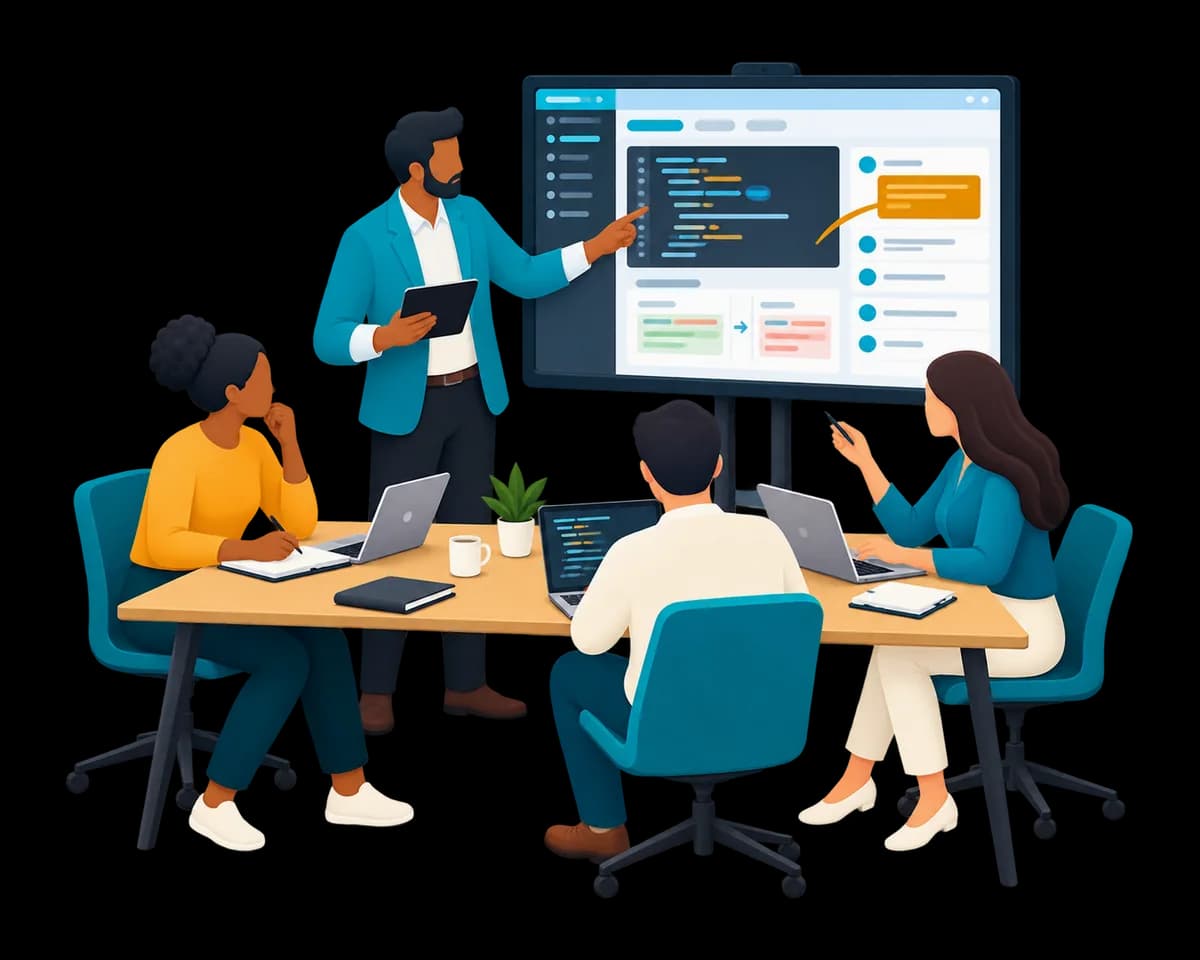
The commercial shape of it
- Timeline
- 8 weeks to a team you can measure
- Cost
- Scoped per engagement rather than sold from a price list, and quoted in writing before anything starts. How pricing works
- Built for
- Small and mid-sized software teams · Manufacturing · Professional services · Distribution and wholesale
What you get
- A measured starting point for your team, not a self-assessment
- A programme built on your own tools and next projects
- Real project work, marked by a senior engineer, with written feedback
- A hiring scorecard your managers can run themselves
- A clear next step for each person
- A closing report against the starting point
The room it happens in
Nobody has a spare afternoon, because the person who would teach a junior is the same person shipping this quarter. The interview measured how well someone interviews, so you find out what they can really do in month four. And the training budget buys certificates that tell you nothing about what anyone can now do.
Any of this sound familiar?
- You hire people with promise, then nobody has time to teach them.
- Your senior engineer spends half their week answering the same questions.
- Training budget buys certificates that prove nothing about what anyone can do.
- Good people leave because they stopped learning anything.
- You cannot afford senior hires, and juniors take a year to be useful.
If two or more of those are yours, this page is about you.
That is not a management problem. It is simple arithmetic. You hire for potential, and then nobody is free to grow it.
What it costs you
The good juniors leave at about eight months, because nothing was happening. So you decide that hiring at that level does not work for a company your size.
It does. It just needs someone else to run the teaching.
Why now
McKinsey looked at who is actually getting a return from AI. The winners share one habit. They are 3.6 times more likely to change how the work is done. More than half rebuild the process, rather than bolt AI onto it.
Rebuilding a process is a judgement skill. It needs people who understand both the work and the technology. So the companies that win are the ones who built that skill, and it is learnable far faster than most people expect.
What we do differently
We do the teaching, so your senior does not have to. The programme is built around what your team will actually work on next. Your language, your tools, your setup. A course about technology you do not use produces someone good at technology you do not use.
A hiring scorecard that tests work, not conversation. It runs against real tasks, so the month-four surprise happens in week one instead. It is the same scorecard we use for our own hiring.
Real work, marked, with written feedback. We test where people actually are at the start, which is almost never where the CV suggests. Then we report against that at the end. You see what changed rather than taking our word for it.
Ask it from your phone
The systems we build can be asked questions, and we teach your team to use that. So the skill and the software arrive together, instead of the software arriving and nobody opening it.
A team lead: "Who has not finished the deployment module, and what is holding them up?"
The system: Three people. Two are waiting on cloud access from IT, asked for eleven days ago.
That is the difference between a programme you have to chase and one that tells you what it needs.
How it works
Measure. Where the team actually is, tested rather than guessed.
Design. A programme on your tools, aimed at what they build next.
Mark. Project work reviewed by a senior engineer, with written feedback.
Report. A closing report against the starting point, and a next step for each person.
What we guarantee
Every programme is built for one team, and priced in writing before it starts. That is why there is no per-person price here. You are not buying a video library, and a fixed catalogue would mean teaching your team what we chose rather than what they need.
We assess. We do not hand out certificates. You get a report on what each person can now do, with the evidence attached. That includes a straight answer about anyone who is not going to get there. It is usually the most valuable line in the report, and the one most providers will not give you.
We do not quote salary figures, ours or anyone else's. We tell you what your team will have built, and who checked it.
Four weeks covers a first working version, agreed in writing before we start. Very large programmes, work spanning many systems, and moving data out of software that cannot export it are all priced separately. Read what four weeks includes.
On every engagement
- You own it, and you can leave. Your code, your data, your accounts. Taking it in-house or to another supplier is a handover, not a negotiation.
- Built for India's DPDP Act. Identity kept separate from the consent and audit record, no personal data in URLs, and none in logs.
- Security enforced by the build. Secrets scanned on every commit, payloads size-checked before parsing, every write endpoint rate limited. If a check fails, nothing ships.
- Anything with AI in it is measured. An evaluation set, a human review step wherever a wrong answer costs money, and drift monitoring after go-live.
How we build, where your data lives, and exactly where we stand on certification — all of it is on our security page.
Asked and answered
How is this different from sending people on a course?
We are twelve people. Is this for us?
What if we need the skills faster than a programme takes?
The other 11
Next step
Start with the one that hurts most
Bring us your team. Roles, rough experience, and what they will build next. On the call we go through where the real gaps are and what a programme would need to cover, before we talk about price.