
Learning & training platforms
Backed by a running systemYou don't have a training problem. You have a "who hasn't done it yet" problem.
Courses, membership, discussions and progress, built on a platform that already runs in production.
The commercial shape of it
- Timeline
- 4 weeks to your first working version
- Cost
- The call is free; a scoping engagement follows, then the build is quoted against the scope it produces. The three steps and the figures
- Built for
- Professional services · Manufacturing · Healthcare · Education
- Runs today as
What you get
- A working training platform on your domain, with your branding
- Your existing company logins, so there is no second list of people
- Courses, chapters and activities set up
- Membership, roles and who can see what
- Discussion spaces with your rules set before launch
- The overdue report — who has not done what, and by when
The room it happens in
The platform keeps its own list of people, so the moment someone joins or leaves and only one system gets updated, it is wrong. Completion percentages are the easiest number to produce and the least useful. And the rules for what people can post get decided during the first argument, which is how you end up with rules you never meant.
Any of this sound familiar?
- You cannot show who has completed the training they had to.
- New starters learn by sitting next to whoever is free.
- Course material lives in one person inbox.
- Compliance training is tracked on a spreadsheet nobody trusts.
- People finish a course and nothing records that they did.
If two or more of those are yours, this page is about you.
And nobody can answer it without exporting three files.
What it costs you
A compliance question you cannot answer. Joining that depends on somebody remembering to send a checklist. And a certificate expiring that nobody is watching.
Why now
Gartner expects 15 per cent of everyday work decisions to be made automatically by 2028. In 2024 it was none.
For a training platform, the interesting part is not the automation. It is what has to be true first. A system can only act on "chase everyone who is overdue" if it can be asked that in the first place. Most training platforms still need a person to build that report.
What we do differently
It uses your existing company logins. One place for identities, so joiners and leavers flow through instead of being updated twice. It is dull, and it is the single decision that determines whether the platform is still accurate in two years.
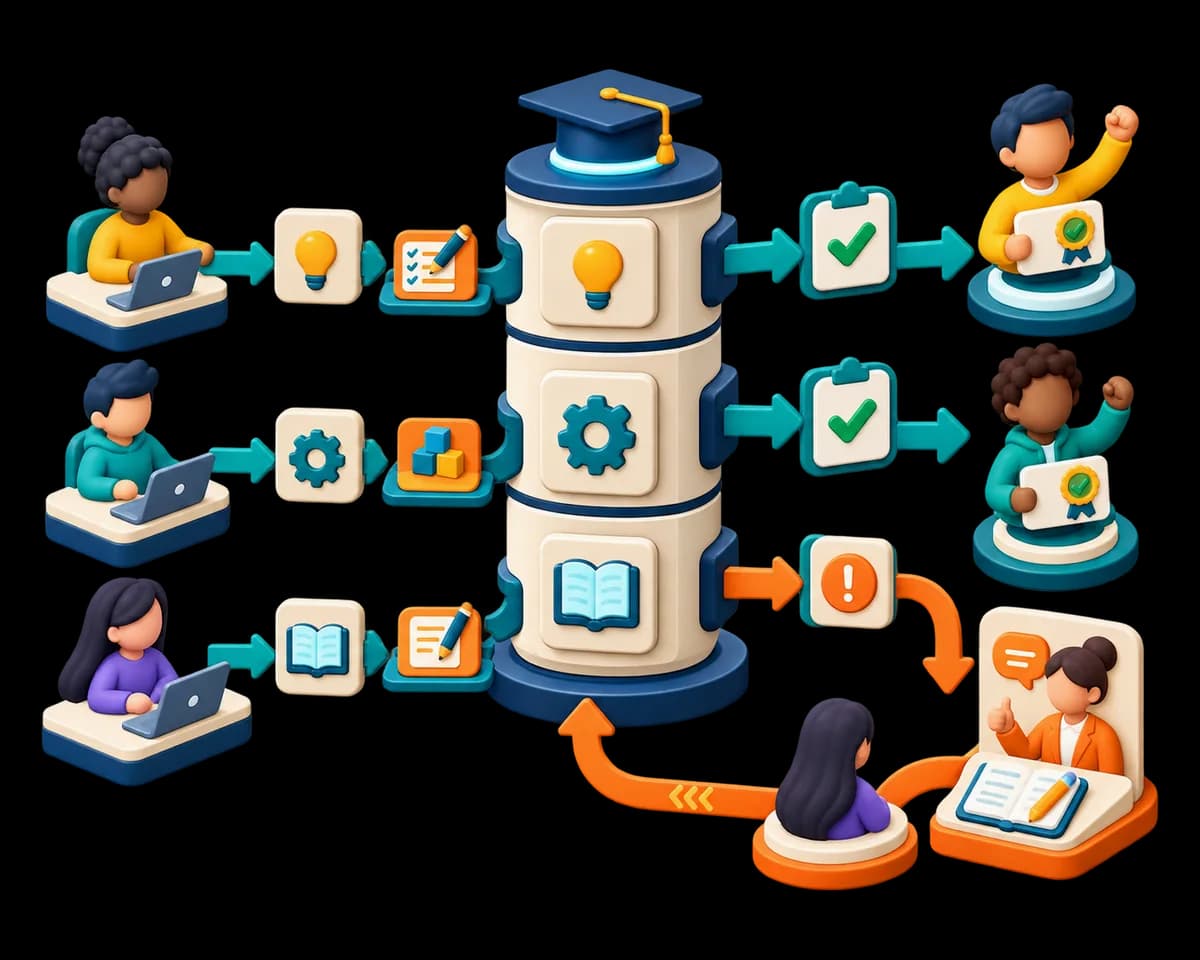
The overdue report gets built during the project. Who has not done what they were told to, and by when. For joining, for compliance, for a certificate about to expire. It is always the first thing asked for a month after launch, so we build it first.
Your posting rules are set before you need them. The platform already handles banned words, blocked links, slowing people down and locking old threads, because it moderates a real community today. We set them to your policy up front, not during the first incident.
Ask it from your phone
A training manager: "Who is overdue on the safety module, and when do their certificates expire?"
The system: Eleven overdue. Four expire this month. Two in Pune, two in Coimbatore.
Manager: "Remind those four and their managers, and book the refresher."
The system: Reminders sent. Session booked for the 19th.
No export, no spreadsheet, no waiting until Thursday.
How it works
Connect. Your existing company logins.
Build. Courses, chapters, activities, roles and who can see what.
Set the rules. Posting and moderation, agreed before the first incident.
Report. Progress, completion, and the overdue view people actually ask for.
What we guarantee
This job covers the platform. Structure, logins, moderation, reporting and moving your existing material across. You write the course content, or we do it as a separate job with its own scope. That split is deliberate. Content and platform move at completely different speeds, and putting them together is how a launch slips by months.
We connect the video tool you already use rather than building another one. Your team knows it, and it works.
Exams with supervision and official qualifications are questions about awarding bodies, not about software. If you need them, tell us early and we will tell you what is really involved.
Four weeks covers a first working version, agreed in writing before we start. Very large programmes, work spanning many systems, and moving data out of software that cannot export it are all priced separately. Read what four weeks includes.
On every engagement
- You own it, and you can leave. Your code, your data, your accounts. Taking it in-house or to another supplier is a handover, not a negotiation.
- Built for India's DPDP Act. Identity kept separate from the consent and audit record, no personal data in URLs, and none in logs.
- Security enforced by the build. Secrets scanned on every commit, payloads size-checked before parsing, every write endpoint rate limited. If a check fails, nothing ships.
- Anything with AI in it is measured. An evaluation set, a human review step wherever a wrong answer costs money, and drift monitoring after go-live.
How we build, where your data lives, and exactly where we stand on certification — all of it is on our security page.
Asked and answered
We already use Teams or Google Workspace. Does this duplicate that?
What about learners who do not work for us?
Can we bring our existing courses across?
The other 11
Next step
Start with the one that hurts most
Bring your list of required training. What people must complete, and by when. On the call we go through what the reporting needs to look like and what your logins would have to support.