
AI and automation
Built to orderEvery business has three jobs that could run themselves. The skill is knowing which three.
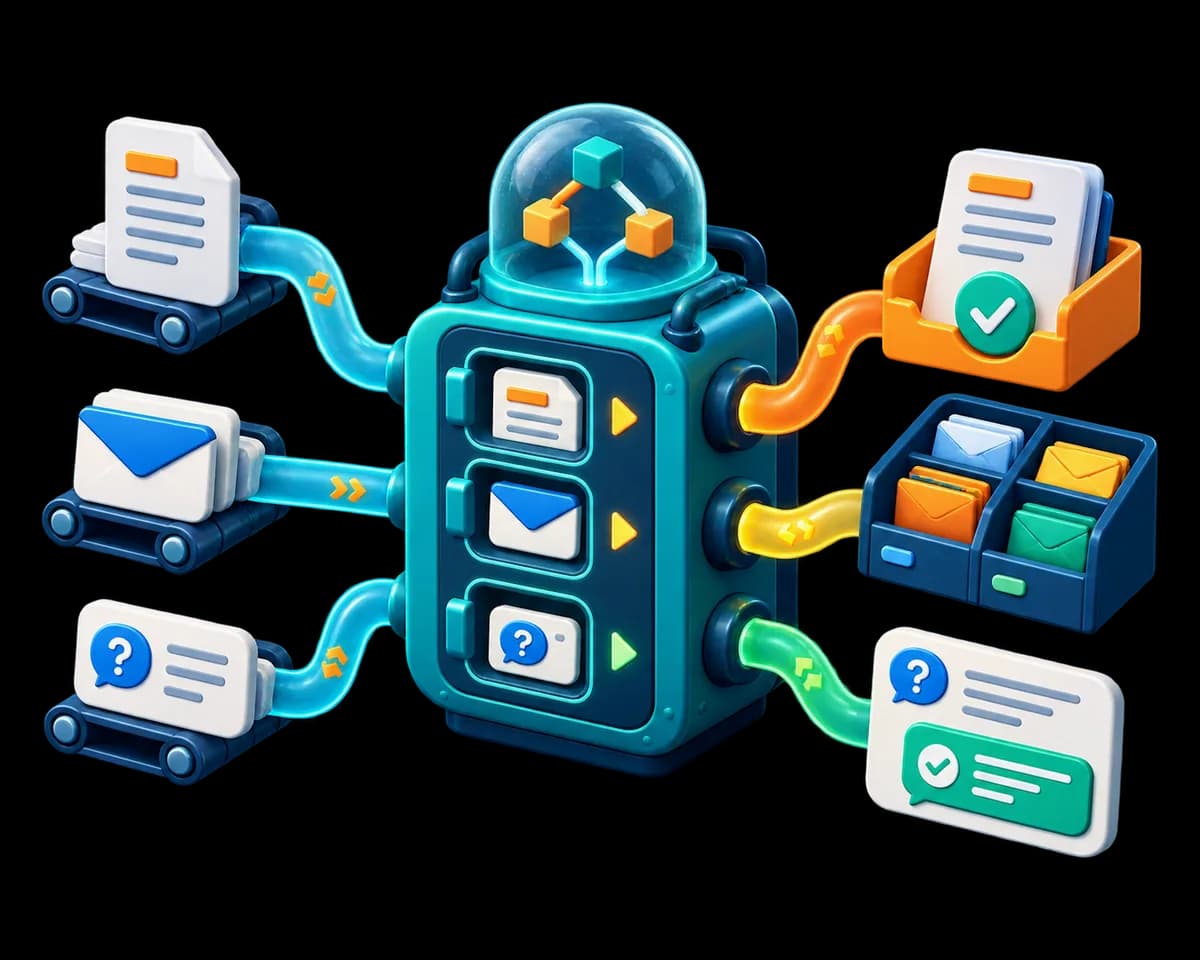
AI where it really fits. Reading documents, sorting what arrives, answering questions from your own files.
The commercial shape of it
- Timeline
- 4 weeks to your first working version
- Cost
- The call is free; a scoping engagement follows, then the build is quoted against the scope it produces. The three steps and the figures
- Built for
- Professional services · Manufacturing · Distribution and wholesale · Education · Healthcare administration
What you get
- One job automated from start to finish, on your own system
- A test set built from your real cases, where the answers are already known
- A measured score on your own files, with the mistakes named
- A person checking the work wherever a wrong answer costs money
- A way for your team's own AI tools to ask the system questions
- Ongoing checks, so accuracy cannot slip quietly after launch
The room it happens in
One person is the bottleneck for a whole process. They read the invoices, or sort the tickets, or know where the policy lives. The same question gets three different answers, because three people answer it from memory. And work arrives faster than anyone can read it, so it piles up where nobody can see it.
Any of this sound familiar?
- One person reads every invoice, and nothing moves when they are on leave.
- The same question gets three different answers from three people.
- Work arrives faster than anyone can read it.
- Somebody retypes the same thing into two systems every morning.
- You know a job could be automated, but not whether it is worth it.
If two or more of those are yours, this page is about you.
You already have a shortlist in your head. The thing someone retypes every morning. The question your team answers forty times a month from the same document. The pile that waits for one person to come back from leave.
The hard part was never the technology. It was knowing which of those is worth automating, and being able to prove it worked.
What it costs you
Not the wages of the person doing it. The waiting.
The invoice sits for two days. The ticket comes back on Thursday. A customer waits while somebody rebuilds an answer that already exists in a document.
Waiting never appears on an invoice, and it is usually the biggest cost of the lot.
Why now
Google and the India SME Forum asked 3,249 small and mid-sized businesses about this. Their finding: putting AI into everyday operations could lift profits by 30 to 35 per cent, and add more than $490 billion across the sector.
Those are numbers for businesses your size, in this market. What changed is not that AI became possible. It is that using it on one ordinary back-office job got cheap enough to be worth doing.
What we do differently
We tell you which job first, in writing. Before anything is built, you get a short call about the job you bring us. What can be automated, what it would be worth, and what has to be true first. That answers the question with evidence rather than enthusiasm.
We measure it on your work, not on a sales demo. We take real cases where you already know the right answer, and that becomes the target. You get a score on your own files before it touches anything live. So "three people, three answers" becomes one answer you can check.
A person approves anything expensive. Where being wrong costs money, someone checks the work first, and you can see what is waiting.
Ask it from your phone
Everything we build can be asked questions directly, using the standard the whole industry now agrees on.
You, in a car park: "How many supplier invoices are waiting on someone, and which are over thirty days?"
The system: Fourteen waiting. Four over thirty days. Three with Priya, one nobody has picked up since the 2nd.
You: "Give the unassigned one to Priya, and remind me about the other three tomorrow."
The system: Done. Recorded against your name at 16:42.
You did not open anything. It was still your permission and your record. Asking is just a new door into the same house.
This is not a promise about what we will learn to do. We already publish software that works this way.
browesp runs browser tasks in your own browser, with your own logins. CodraGraph
lets an assistant answer questions about a codebase. So does this website.
Orfyn is ours too, and live: an AI engineer that runs on your own infrastructure, under your own keys, doing the integration work that decides whether a pilot ever reaches production. Building it is why the systems we build for you arrive ready to be asked questions, rather than having it bolted on later.
How it works
Read. We look at your real cases and read the results by hand, before automating any judgement about them.
Measure. We build the test set and give you an honest starting score.
Build. The system, with a person checking anything that costs money to get wrong.
Watch. Ongoing checks, and the same test set run against every change.
What we guarantee
We agree what is included in writing before the clock starts. What the system will do, what it will not, and how we will both know it worked. That document is what makes a fixed date mean anything, and you get it before you commit to a build.
We give you an accuracy number after the first week, once the test set exists and we have measured something real on your files. Not before. A number quoted before we have seen your data is a guess, and you would be right not to trust it.
Some work has to be right every single time. Tax, statutory filings, payroll sums. There we build the checks and the human approval around the work. We do not hand the decision to a machine. That is a deliberate choice, and we will explain it on the call.
Four weeks covers a first working version, agreed in writing before we start. Very large programmes, work spanning many systems, and moving data out of software that cannot export it are all priced separately. Read what four weeks includes.
On every engagement
- You own it, and you can leave. Your code, your data, your accounts. Taking it in-house or to another supplier is a handover, not a negotiation.
- Built for India's DPDP Act. Identity kept separate from the consent and audit record, no personal data in URLs, and none in logs.
- Security enforced by the build. Secrets scanned on every commit, payloads size-checked before parsing, every write endpoint rate limited. If a check fails, nothing ships.
- Anything with AI in it is measured. An evaluation set, a human review step wherever a wrong answer costs money, and drift monitoring after go-live.
How we build, where your data lives, and exactly where we stand on certification — all of it is on our security page.
Asked and answered
How do we know it still works in six months?
What if plain software would suit us better?
Who is responsible when it gets something wrong?
The other 11
Next step
Start with the one that hurts most
Bring us one job that eats time. Tell us what arrives, what someone does with it, and what comes out. On the call we go through what could be automated, what it would be worth, and what it would take.